<?xml version="1.0" encoding="utf-8"?><feed xmlns="http://www.w3.org/2005/Atom" ><generator uri="https://jekyllrb.com/" version="3.10.0">Jekyll</generator><link href="https://brokenco.de//feed/by_tag/gopher.xml" rel="self" type="application/atom+xml" /><link href="https://brokenco.de//" rel="alternate" type="text/html" /><updated>2026-10-31T17:58:32+00:00</updated><id>https://brokenco.de//feed/by_tag/gopher.xml</id><title type="html">rtyler</title><subtitle>a moderately technical blog</subtitle><author><name>R. Tyler Croy</name></author><entry><title type="html">Gopher it</title><link href="https://brokenco.de//2020/08/06/go-for-it.html" rel="alternate" type="text/html" title="Gopher it" /><published>2020-08-06T00:00:00+00:00</published><updated>2020-08-06T00:00:00+00:00</updated><id>https://brokenco.de//2020/08/06/go-for-it</id><content type="html" xml:base="https://brokenco.de//2020/08/06/go-for-it.html"><![CDATA[<p>The web is getting faster but feeling slower, something which I have
complained about loudly on <a href="https://twitter.com/agentdero">Twitter</a> but now
some folks have put together <a href="https://www.nngroup.com/articles/the-need-for-speed/">data to back it
up</a>. The web is
simultaneously a medium to transmit documents (e.g. an article) and an
application platform (e.g. Jira). Anecdotally it seems to me like far too many
publishers think of the web only as the <em>latter</em>. There are more and more
websites which require significant JavaScript or other multimedia resources to
render what ends up being a few paragraphs of text. If you don’t believe me,
just visit the website for your local television news station with
<a href="https://noscript.net/">NoScript</a> turned on. In my own way, I have been
resisting this push by keeping this blog as barebones as neceessary to present
the content you’re reading now. On a whim, I recently took this idea a little
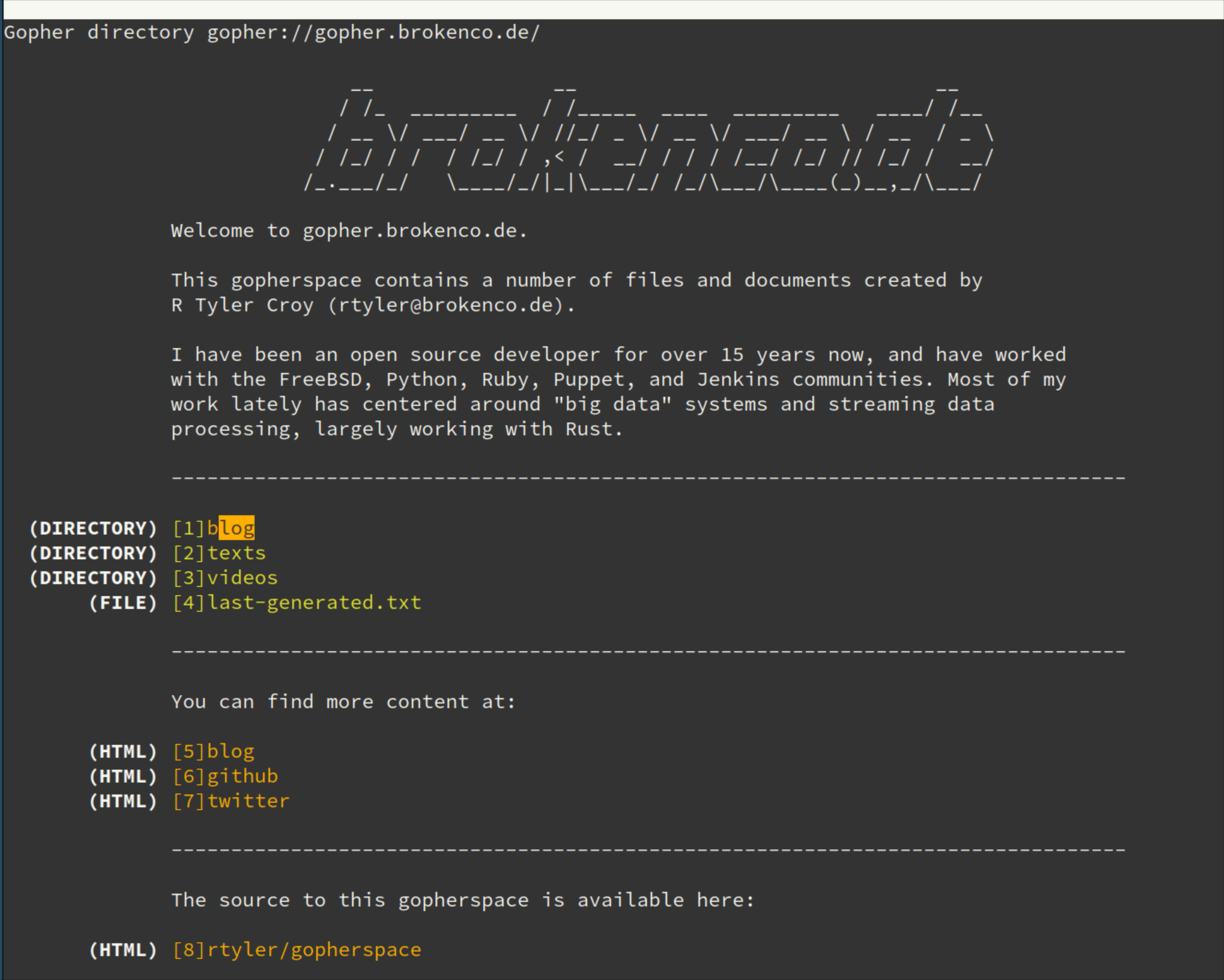
bit further by deploying a <a href="gopher://gopher.brokenco.de/">Gopher site</a> (viewable over HTTP via <a href="https://gopher.floodgap.com/gopher/gw?a=gopher%3A%2F%2Fgopher.brokenco.de">a proxy</a>).</p>

<p><img src="/images/post-images/2020-gopher/gopherspace.png" alt="gopher.brokenco.de viewed with elinks" /></p>

<p><a href="https://en.wikipedia.org/wiki/Gopher_(protocol)">Gopher</a> is old, somewhat
primitive, but still captures my interest because of those qualities. By and
large I have filled up my gopher site with this blog content, a couple other
text files, and archives of some of my video presentations which I
downloaded from YouTube.</p>

<p>When I first started tinkering around with the idea, I was absolutely floored
by how fast content was loading via some of the Gopher sites I was visiting,
even over <a href="https://torproject.org">Tor</a> the responsiveness of sending a few
kilobytes cannot be understated.</p>

<p>I do not plan on publishing too much content “exclusively” via Gopher, since
HTTP is where most things on the internet are happening these days. I have
however set up an automatic publishing pipeline for my blog and other content
to automatically go to <a href="gopher://gopher.brokenco.de">gopher.brokenco.de</a> once
it has been committed.</p>

<p>Personally I find <a href="http://elinks.or.cz/">elinks</a> to be a good Gopher client,
though others <a href="https://github.com/xvxx/phetch">do exist</a>. If you’re interested
in exploring some of the content that lives on the interview via Gopher, I
recommend starting at <a href="gopher://gopherproject.org">gopherproject.org</a>. Have
fun! :)</p>]]></content><author><name>R. Tyler Croy</name></author><category term="gopher" /><category term="opinion" /><summary type="html"><![CDATA[The web is getting faster but feeling slower, something which I have complained about loudly on Twitter but now some folks have put together data to back it up. The web is simultaneously a medium to transmit documents (e.g. an article) and an application platform (e.g. Jira). Anecdotally it seems to me like far too many publishers think of the web only as the latter. There are more and more websites which require significant JavaScript or other multimedia resources to render what ends up being a few paragraphs of text. If you don’t believe me, just visit the website for your local television news station with NoScript turned on. In my own way, I have been resisting this push by keeping this blog as barebones as neceessary to present the content you’re reading now. On a whim, I recently took this idea a little bit further by deploying a Gopher site (viewable over HTTP via a proxy).]]></summary></entry></feed>